
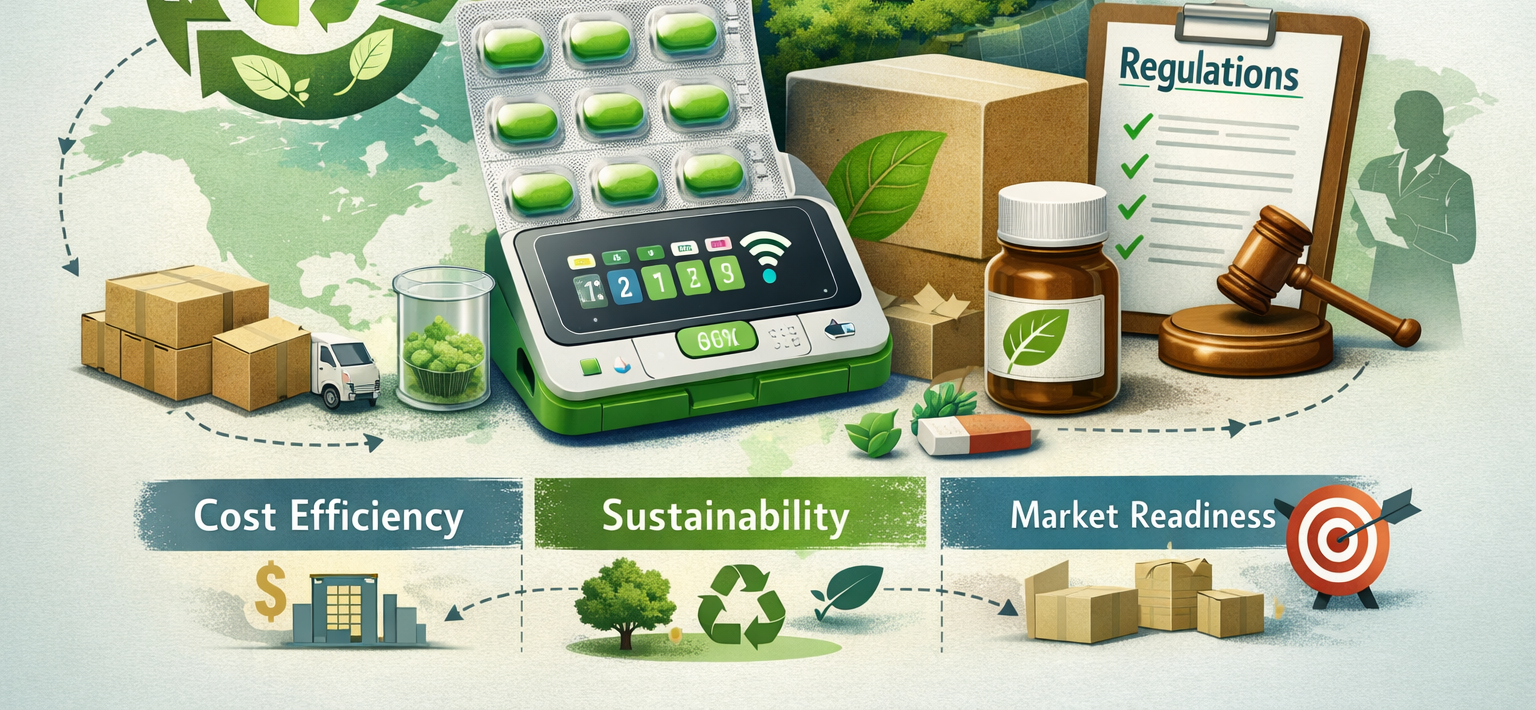
Large pharmaceutical companies are increasingly adopting sustainable packaging, showing a shift in how operational decisions, including manufacturing, logistics, and packaging, influence competitive positioning in the market1. What was once treated as a technical or regulatory situation is now becoming relevant as a strategy to stand out1.
For early-stage biotech companies, packaging decisions made early in development can shape regulatory pathways, cost structures, procurement discussions, and investor perception. Alongside this, the increase in expectations around sustainability from regulators, investors, and consumers are raising attention on how medicines should be packaged and delivered1.
Across the pharmaceutical industry, large companies are investing in operational sustainability, focusing on design changes that reduce material use, manufacturing complexity, and downstream waste - not just carbon emissions2.
Through what research shows, sustainable innovations draws on service design and circular economy frameworks. For example, researchers have proposed integrating RFID-enabled reusable pillboxes into existing healthcare service systems, aiming to reduce packaging waste, whilst improving patient experience and adherence3.
On an industry scale, these ideas are being introduced. A recent example is Chugai Pharmaceutcial’s WorldStar award-winning blister pack design, which emphasises material reduction, recyclability, and manufacturing efficiency in oncology packaging4.
Together, these developments suggest that theoretical research into innovative, sustainable solutions is already shifting into practical, scalable packaging solutions.
There are several drivers behind the traction sustainable packaging is gaining across biotech and pharma sectors.
Life cycle assessments (LCAs) show that packaging materials, particularly aluminium and PVC used in blister packs, have the most environmental harm in pharmaceutical packaging5.
Research comparing disposal methods indicate that take-back schemes, recycling, and controlled incineration often result in lower environmental impacts than domestic landfill disposal. These findings have led to ecodesign initiatives, such as reducing packaging volume and selecting lower-impact materials6.
Furthermore, research already finds a 38-44% reduction in life cycle impacts through improved, eco-friendly designs of blisters and sachets7. There are further suggestions that redesigned blisters and sachets can reduce life cycle impacts by 38-44%, highlighting that relatively small design changes can deliver meaningful sustainability gains7.
Packaging sustainability requirements are also tightening, particularly in Europe, with UK policy expected to follow EU direction2. At the same time, environmental, social and governance (ESG) considerations are increasingly used by investors to assess operational risks and long-term resilience, rather than purely ethical positioning89.
The following framework highlights the type of questions analysts ask when assessing packaging approaches, particularly in biotech and pharmaceutical companies. This can help evaluate operational decisions strategically.
| Consideration | Why It Matters | Starter Questions |
|---|---|---|
| Material choice | Cost and regulatory complianes | What materials are used, and how do they avoid compliance? Can we avoid mixed polymers? |
| Waste footprint | Environmental and procurement factors | How recyclable is our design? how is packaging disposed of? Are there any alternatives? |
| Usability | Patient experience | Does packaging design support the purpose and use of product? |
| Regulatory trajectory | Long-term compliance | How might future regulations affect this packaging choice? |
| Cost impacts | Unit economics | How could this decision influence manufacturing and logistics costs at scale? |