
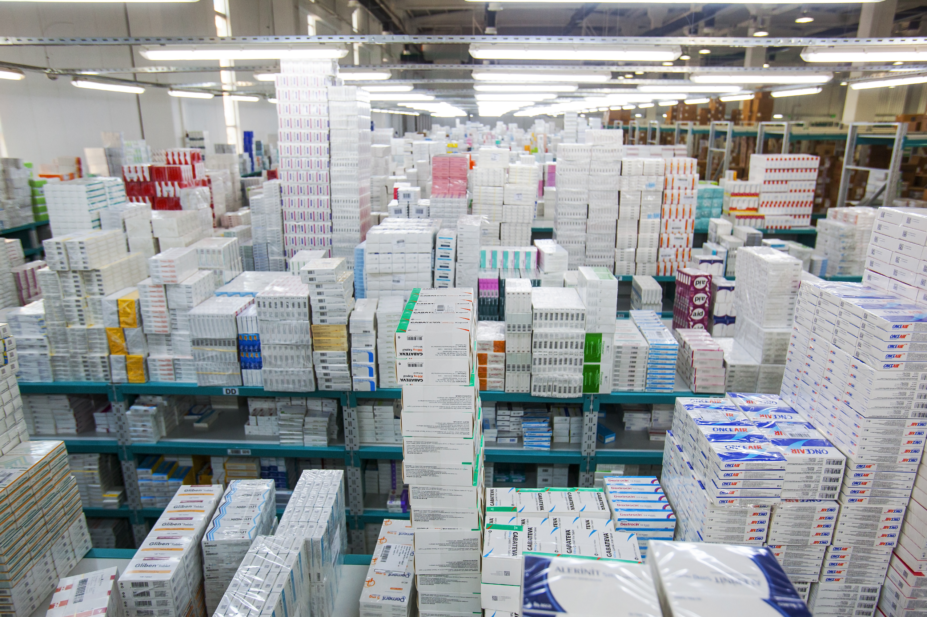
The first major pharma Direct-to-Consumer (DTC) launch occurred in 2024 with Eli Lilly’s introduction of the LillyDirectTM platform in the US market1. The platform includes LillyDirectTM Pharmacy Solution – an online pharmacy where patients can order Lilly’s medicines and have them delivered home free of charge. The company stated that the launch aims to relieve the burden for patients with chronic disease when navigating the complex U.S. healthcare system and improve patient outcomes as a result.
A host of other pharmaceutical companies have recently launched their DTC platforms in the US market: Genentech, Amgen, Bristol Myers Squibb, AstraZeneca, Novartis, and Boehringer Ingelheim2. This is in response to President Trump’s call for major pharmaceutical companies to adopt the DTC model to achieve Most-Favoured-Nation (MFN) drug pricing3. MFN aims to allow Americans to pay the same drug prices as those in peer countries4.
DTC is a distribution strategy where the businesses sell their products directly to consumers, bypassing intermediates (e.g., wholesalers, retailers).
Although the specific distribution route will likely differ by companies and by countries, the typical route involves the pharmaceutical company (the drug manufacturer), the wholesaler, and the pharmacy5.
Wholesalers and pharmacies are intermediaries. Each time a drug passes through an intermediary, its price gets marked up, thereby increasing the final price to patients. If the patient is covered by health insurance, the healthcare plan will bear this price. Typically, the health insurer will negotiate with the pharmaceutical company to receive better prices in exchange for more favourable inclusion in the healthcare plan.
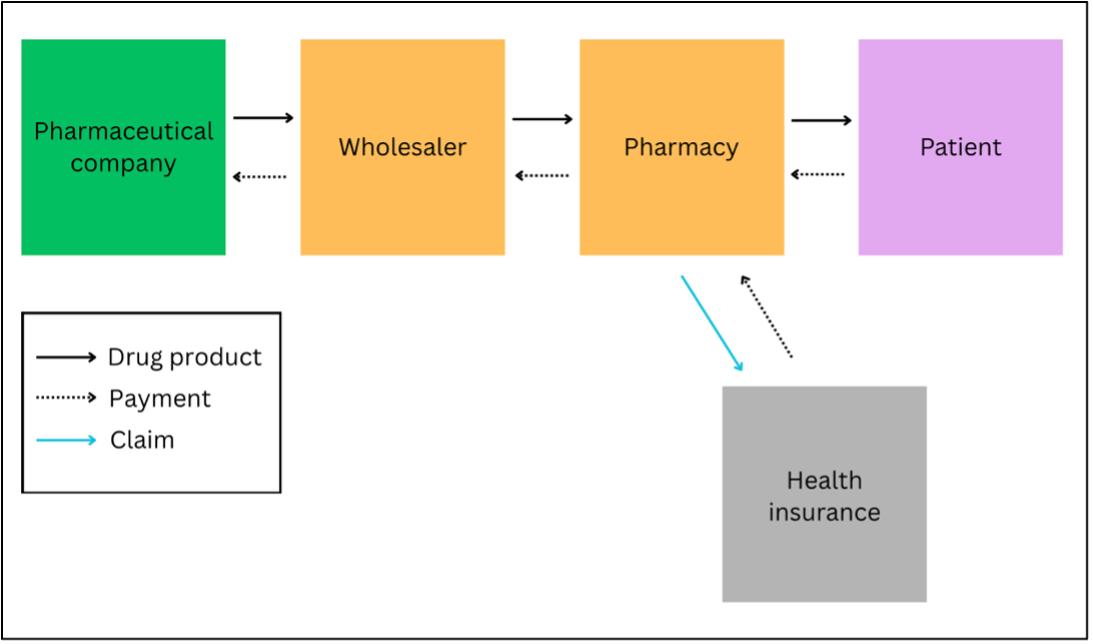
A typical pharmaceutical distribution route.
The nature of the U.S healthcare system facilitated the emergence of Pharmacy Benefit Managers (PBMs). Over 60% of US residents are on private healthcare plans6. PBMs act as a middleman, managing negotiations between pharmaceutical companies and the large number of private health insurers, along with other services7. This is in contrast with the United Kingdom’s universal healthcare system, where drug manufacturers negotiate prices with the NHS, and patients are charged a fixed prescription charge of £9.90 per item8.
PBMs take a share of the savings obtained for their clients. This means savings might not be passed to patients in the form of reduced co-payments/insurance premiums. The activities of PBMs have largely gone under the radar until June 2022, when the Federal Trade Commission launched an investigation into the PBMs industry9. Later, in September 2024, a report was submitted to the U.S. Department of Health and Human Services, highlighting that PBMs enjoy much greater margins than other middlemen in the pharmaceuticals supply chain10.
In theory, this shift should reduce the drug prices for patients. In practice, however, this saving might not be realised since DTC sales are treated as cash transactions. In the U.S healthcare system, this means these purchases might not be covered by insurance. In a recent survey on 1000 Americans, 72% respondents are likely to use DTC drug sale services, yet 86% are also concerned about using them2. Insurance coverage was the most cited concern, raised by over 50% respondents. Certain groups might still benefit, such as uninsured individuals or those whose medicines are not covered by their plans.
Direct interaction with patients could also enable pharmaceutical companies to collect valuable market insight data and build greater trust with patients.
The case highlights the difference between healthcare systems globally and how pharmaceutical companies must adapt strategies to navigate different systems.
Keep an eye on the DTC landscape in the next few years to see the impacts on drug prices, patient outcomes, and pharmaceutical performance in the U.S market. If the impacts are positive, this could be a lesson on the value of challenging the norm and taking the risk to break the status quo.
It is also a lesson on the importance of timing – Eli Lilly happened to launch the LillyDirectTM platform just a year before Donald Trump’s pharmaceutical shake-up. It could also be the case that Lilly predicted the scenario and took early steps to manage it.
Eli Lilly and Company. Lilly Launches End-to-End Digital Healthcare Experience through LillyDirect™. Available at: https://www.prnewswire.com/news-releases/lilly-launches-end-to-end-digital-healthcare-experience-through-lillydirect-302025738.html. Accessed 25 October 2025.
Park A. Three-quarters of consumers are interested in DTC drug sales, but even more still have concerns. Available at: https://www.fiercepharma.com/marketing/three-quarters-consumers-are-interested-dtc-drug-sales-even-more-still-have-concerns. Accessed 25 October 2025.
Debevoise&Plimpton. “Pharm-to-Table”: The Impact of Direct-to-Consumer Pharmaceutical Sales on Patient Access, Market Dynamics and Investor Strategy. Available at: https://www.debevoise.com/insights/publications/2025/09/pharm-to-table-the-impact-of-direct-to-consumer. Accessed 26 October 2025.
The White House. Delivering Most-favored-nation Prescription Drug Pricing To American Patients. Available at: https://www.whitehouse.gov/presidential-actions/2025/05/delivering-most-favored-nation-prescription-drug-pricing-to-american-patients/.
The Health Strategies Consultancy LLC. Follow The Pill: Understanding the U.S. Commercial Pharmaceutical Supply Chain. Available at: https://www.kff.org/wp-content/uploads/2013/01/follow-the-pill-understanding-the-u-s-commercial-pharmaceutical-supply-chain-report.pdf. Accessed 25 October 2025.
Tikkanen R, Osborn R, Mossialos E, Djordjevic A, Wharton GA. International Health Care System Profiles. United States. The Commonwealth Fund. Available at: https://www.commonwealthfund.org/international-health-policy-center/countries/united-states. Accessed 28 October 2025.
Thomson Reuters. Glossary. Pharmacy Benefit Manager (PBM). Available at: https://uk.practicallaw.thomsonreuters.com/w-020-4152?transitionType=Default&contextData=(sc.Default)&firstPage=true. Accessed 26 October 2025.
NHS UK. NHS prescription charges. Available at: https://www.nhs.uk/nhs-services/prescriptions/nhs-prescription-charges/. Accessed 26 October 2025.
Congress.gov. Pharmacy Benefit Managers: Current Legal Framework. Available at: https://www.congress.gov/crs-product/LSB11080?utm_source=chatgpt.com. Accessed 27 October 2025.
Eastern Research Group Inc. An Examination Of Pharmaceutical Supply Chain Intermediary Margins In The U.S. Retail Channel. Available at: https://aspe.hhs.gov/sites/default/files/documents/db1adf86053b1fda8ae9efd01c10ddc8/Pharma%20Supply%20Chains%20Margins%20Report_Final_2024.09.27_Clean_508.pdf. Accessed 25 October 2025.