
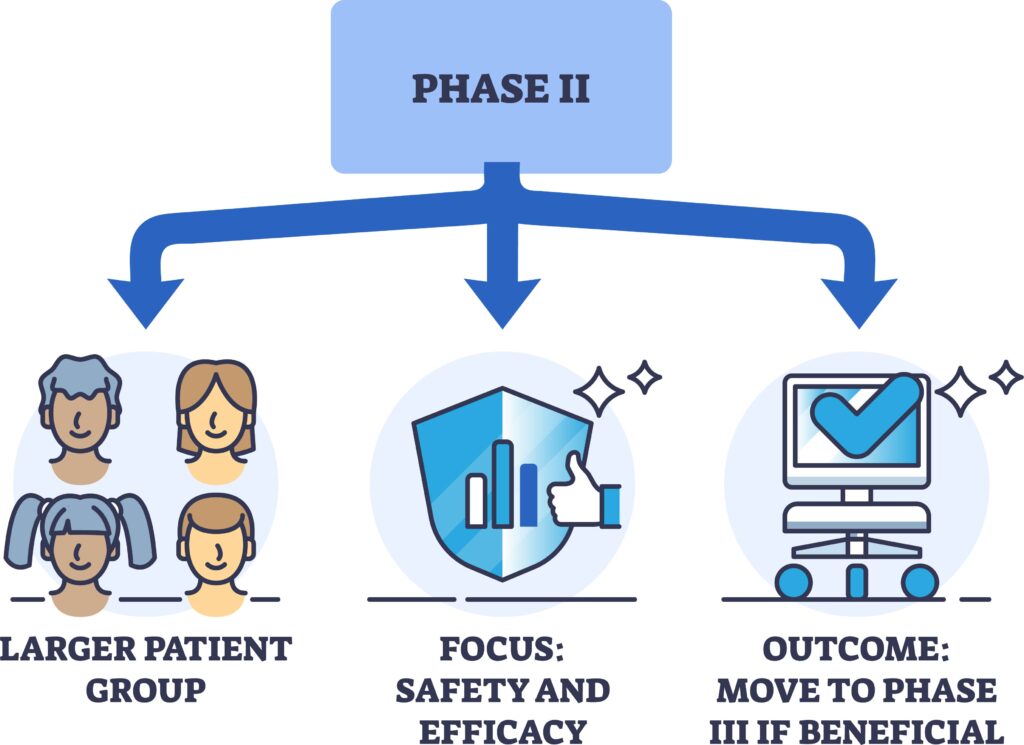
When a drug fails in clinical development, the default explanation is weak science. Yet industry-wide data suggests a more nuanced reality. Most drugs entering clinical trials never reach approval, and Phase II remains one of the largest attrition points in the development pipeline.12
What makes this significant is that candidates reaching Phase II have already demonstrated acceptable safety in humans. They rarely fail because they are dangerous. They fail because demonstrating clinical efficacy in real patients is far more complex than generating promising laboratory data.
Phase I trials assess safety and dosing. Phase II asks the more demanding question: does the drug work?
Historical analyses show that only a minority of drugs entering Phase II progress to Phase III.1 Unlike preclinical experiments conducted under controlled conditions, Phase II trials operate in heterogeneous patient populations. Genetics, disease progression, comorbidities and adherence introduce variability that animal models cannot replicate.
The translational gap is well documented. Reviews have highlighted the limited predictive value of certain animal models, particularly in oncology and neurological disease.3 Biomarkers that appear robust in preclinical systems may not correlate with meaningful patient outcomes. Dosing regimens optimised in animals may fail to achieve sufficient target engagement in humans.
These outcomes do not necessarily reflect flawed biology. They reflect the structural difficulty of modelling complex human disease before observing it directly.
Translational uncertainty does not disappear in Phase II; it becomes embedded in trial design.
Regulators such as the U.S. Food and Drug Administration and the European Medicines Agency emphasise that endpoints must demonstrate clinically meaningful benefit rather than statistical movement in surrogate markers.4 If a company selects endpoints misaligned with regulatory expectations, even biologically active drugs may fail to progress.
Patient selection further complicates matters. Broad inclusion criteria may dilute treatment effects, while narrow criteria may constrain recruitment and increase costs. Capital-constrained biotechnology organisations often run smaller studies, heightening statistical risk.
Phase II therefore tests more than therapeutic potential. It tests whether an organisation understands its mechanism well enough to design a study capable of revealing clinical value.
Beyond scientific validation, Phase II represents a commercial inflection point. Mid-stage clinical data materially influences licensing probability, acquisition interest and investor confidence. Industry analyses show that asset valuations rise sharply following positive Phase II readouts, while negative data frequently curtails partnering prospects.2
For biotechnology companies operating with finite runway, Phase II outcomes often determine survival. Failure at this stage may reflect insufficient statistical power, endpoint misalignment or inadequate patient stratification rather than incorrect biological hypotheses.
For the wider biotech and pharmaceutical industry, Phase II attrition underscores a structural challenge: innovation risk is concentrated not in discovery, but in translation.
Companies that integrate regulatory strategy, biomarker validation and patient stratification early are better positioned to withstand this pressure. Larger pharmaceutical groups such as AstraZeneca and Pfizer increasingly emphasise precision trial design and targeted populations to mitigate mid-stage failure risk. The competitive advantage is shifting from molecule novelty alone to organisational capability in clinical execution.
Phase II is not simply a filter for bad science. It is a stress test for translational discipline, statistical rigour and strategic judgement. In an environment of tighter capital and greater regulatory scrutiny, those capabilities may matter more than breakthrough biology alone.